
Modbus TCP/IP Module MAC00-EM41
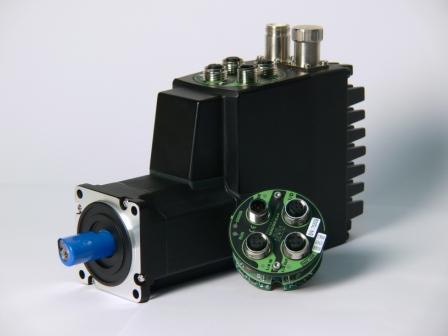
Modbus TCP/IP with M12 connectors many IO.
Key Features
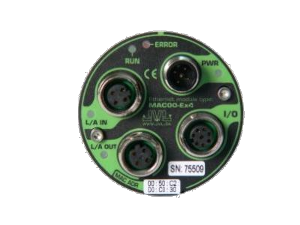
- ✓17 pin M12 connector for IO. Total 4x M12
- ✓Control and setup through Modbus TCP/IP
- ✓Modbus TCP/IP input and output. Switch built-in.
- ✓For built-in PLC with ( MAC400-3000 ) or HWI for MAC050-141 etc.
- ✓4 digital inputs for enable, limit etc.
- ✓2 digital opto-isolated outputs up to 15mA for In Position, Error etc.
- ✓2 analogue inputs for zero search or adjustment etc.
- ✓RS422 for encoder or pulse/direction IO
- ✓Protection IP67
- ✓RS232 interface
Modbus was originally developed by Modicon and today, it is managed by the Modbus-IDA User Organization.
Modbus is an open Master/Slave application protocol, that can be used on several different physical Layers.
Modbus is an application-layer messaging protocol, positioned at level 7 of the OSI model. It provides client/server communication between devices connected on different types of buses or networks.
Modbus-TCP means that the Modbus protocol is used on top of Ethernet-TCP/IP. Modbus-TCP is an open Industrial Ethernet network which has been specified by the Modbus-IDA User Organization in co-operation with the Internet Engeneering Task Force (IETF) as an RFC Internet standard. Modbus devices are certified by the Modbus-IDA User Organization for interoperability and conformance to the Modbus specification.
Disparaged by critics but highly valued by those who have used it, Modbus-TCP isn't really anything new. Rather more, it was solely necessary to approve Ethernet-TCP/IP as an additional data transmission technology for the Modbus Protocol, which has been available since 1979. The well-proven Modbus services and the object model which has been available since the original Modbus protocol version are unchanged, and have simply been adapted to TCP/IP as the data transmission protocol. This extends the Modbus family with an additional product range, which now consists of the classical Modbus-RTU (asynchronous data transmission via RS-232 or RS-485), Modbus-Plus (high speed communication via a Token Passing Network) and Modbus-TCP (Ethernet-TCP/IP-based client/server communication). All of these versions share the same application protocol, which specifies a universal object module for user data and communication services.